
Individuals eligible for CAYA include:
*This does not include individuals whose primary communication disability is a hearing loss. CAYA does not provide hearing aids or assisted listening devices. Individuals with hearing disabilities are encouraged to contact the Wavefront Centre for Communication Accessibility (formerly the Western Institute of the Deaf and Hard of Hearing) in Vancouver www.wavefrontcentre.ca
Service Parameters
In 2023, CAYA received a renewed mandate in the BC provincial budget from the Ministry of Social Development and Poverty Reduction to continue to do the important work of addressing the needs of adults in BC with severe communication disabilities who require AAC (augmentative/alternative communication) services. The official news release from the Government of BC may be viewed here.
This welcome funding will allow CAYA to continue to support clients using communication strategies, supports, techniques and equipment until March 31st, 2028.
CAYA operates in the Community environment; therefore, we are not a rapid response service and there is no coverage for staff vacations or illness.
There is a wait list for service. As of September 2026, the wait-time for service is…
- an average of 6 months,
- a range of 1 – 18 months.
CAYA operates on 3 intake cycles per year, and Requests for Service are triaged and activated based on individual factors including:
- urgency
- geographical locations
- transition issues
- length of time waiting
- other factors as identified
CAYA is a consultative service and engages with Client Teams to empower them to support their client to communicate on a daily basis.
CAYA does not provide speech and language services, swallowing services, nor support to those whose primary communication issue is that they are deaf or hard of hearing.
Who Are CAYA Clients?
CAYA clients have either never had or have recently lost the capacity for functional speech. The origins of these problems stem from problems at birth (e.g. cerebral palsy) or genetic conditions (e.g. Down’s Syndrome) or acquired conditions (e.g. traumatic brain injury, ALS). Most CAYA clients have long-standing communication disabilities and CAYA is there to ensure that they have the communication supports to build an adult life of the greatest possible independence. Teams who support CAYA Clients must agree to participate in the assessment process and continue the implementation of the communication system on a daily/regular basis as part of the Personal Support Plan.
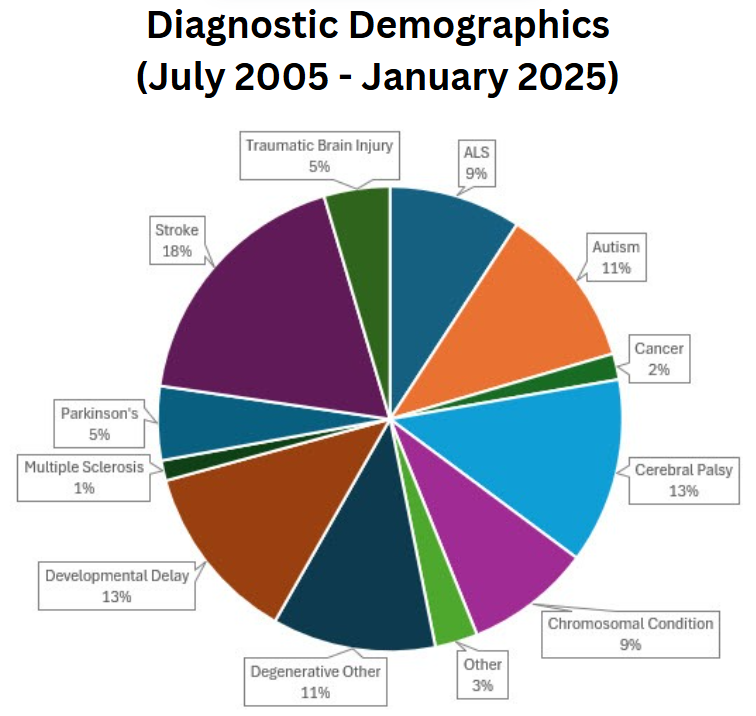
Approximately 50% of CAYA clients have congenital disabilities, and 50% have later acquired disabilities.
